Meet Felicity Book Review American Girls Book 1
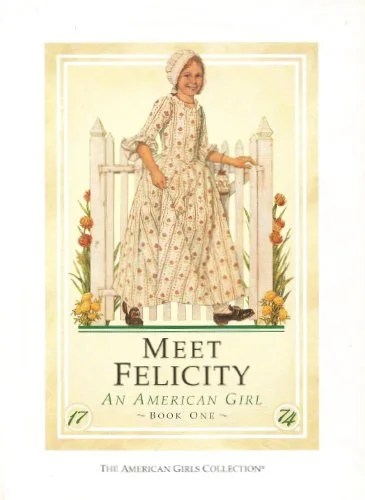
My girls read all the American Girls series when they came out in the 1990s. I’ll confess I didn’t. I mean, they were learning American History, what could be wrong with that?
I think an Amazon review of the book, written by an eight-year-old summarized it nicely.
“Felicity was riding a horse that was not hers. She was also sneaking out at night and lying to her family. She got somebody else's good shorts muddy. She let free a horse that was not hers. All that stuff is why I don't like the book.”
It wasn’t until recently that I read this book, Meet Felicity, with a granddaughter. It’s the first in the six-book Felicity series, set in 1774. As I read, Felicity seemed nothing like an 18th century nine-year-old girl - more like a modern-day girl transported back to the 1700s in a time machine. Felicity has a modern day “feminist” attitude, resisting the role of females of that time.
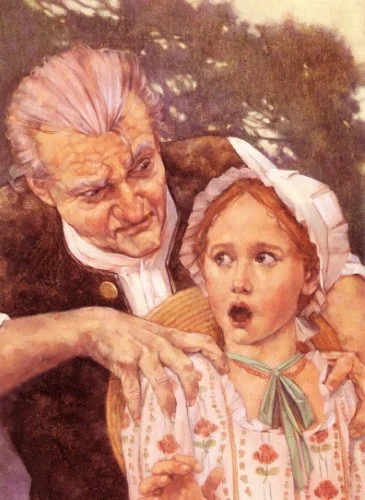
She hears about a new horse acquired by Jiggy Nye, the violent, alcoholic tanner, and has to go see it. Felicity sees Jiggy beating the horse and determines to save her, naming the horse Penny.
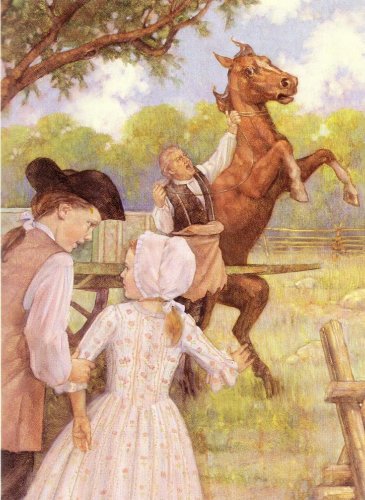
The second time Felicity goes to the tannery, Jiggy Nye grabs her and warns her to stay away and leave his horse alone.
Felicity’s plan includes borrowing (stealing) a pair of breeches from the apprentice, Ben. She hides those in their barn to change into when she sneaks out of the house early each morning to go to Jiggy Nye’s to tame Penny. After a month (at least it was not two days), Felicity climbs onto Penny’s back, from the fence I guess, as no nine-year-old could easily mount a horse bareback. Penny has no saddle, halter, bridle, or reins, merely a rope around her chest (shown in an illustration). Somehow they trot, then canter, and eventually gallop across the field on that first ride.
It’s unclear how much riding experience Felicity has had prior to this. It couldn’t have been much. It’s hard to believe she could stay on the horse trotting, let alone galloping bareback across a field. In the following days, they progress to jumping piles of hay, logs, and fences. She did fall off during their first jump - no injuries of course.
Ben finally discovers what she is doing. When he has a chance to tell the truth; he doesn’t. He keeps Felicity’s secret from her parents.
After five weeks of these early morning escapades, with her parents totally oblivious to what is happening, Felicity rides Penny into town to her father’s shop. She tries to convince him to buy the horse from Jiggy Nye. Her father refuses. Jiggy Nye appears and takes Penny back. He threatens to kill the horse if he sees Felicity near her again.
Soon after that, Felicity goes, in the middle of the night, to Jiggy’s to ride Penny one last time. Felicity has the horse jump the pasture fence. She lets go and falls off (no injury here either). Penny is free.
The book ends rather abruptly. There is no mention of Jiggy Nye missing his horse. There are never any consequences for Felicity’s disobedience and lying. Penny returns in the last two books. I haven’t read them, but apparently Felicity's grandfather pays Jiggy Nye for the horse.
What is the agenda with these types of stories?
It is so common in modern children’s books to portray children in dangerous situations, doing things that could result in serious injury or death, yet in these books, everything turns out well. What kind of seeds does that plant in impressionable children’s minds?
Who in their right mind, today, would want their daughter to even think about repeatedly returning to a violent, alcoholic man’s property, especially after he had already grabbed her and warned her to stay away? The author depicts both parents as totally clueless, for more than a month, about their daughter’s whereabouts and activities. Don’t even get me started on the improbability of a young girl taming a “vicious” horse in a matter of weeks and riding her at high speed bareback and bridleless!
Obviously, the American Girl books are not horse books; however the horse does play a significant role in this Felicity set.
Historical notes:
Women of that day, if they rode horses at all (primarily a few wealthy, upper-class women), rode in a riding “habit” which included a full-length, full skirt. And, they rode sidesaddle. Women riding astride was not socially acceptable until the early 1900s.
Jiggy Nye was abusive to his horse. The author counts on that to justify Felicity’s behavior in a young reader’s mind. I could see from my granddaughter’s reaction that she thought it was good that Felicity was trying to stop him and save Penny. We discussed how that should never have been Felicity’s role. If anyone should have confronted Jiggy, it would have been up to Felicity’s father and/or other men in the village - not a young girl!
There were no laws preventing the abuse of animals in Felicity’s time. Historical fiction should present the standards of the era accurately. We cannot project modern beliefs and practices back into earlier times. The American Society for the Prevention of Cruelty to Animals (ASPCA) was the first humane society formed in the United States, by Henry Bergh in 1866, nearly a hundred years after Felicity’s time.