Bea and the New Deal Horse Book Review
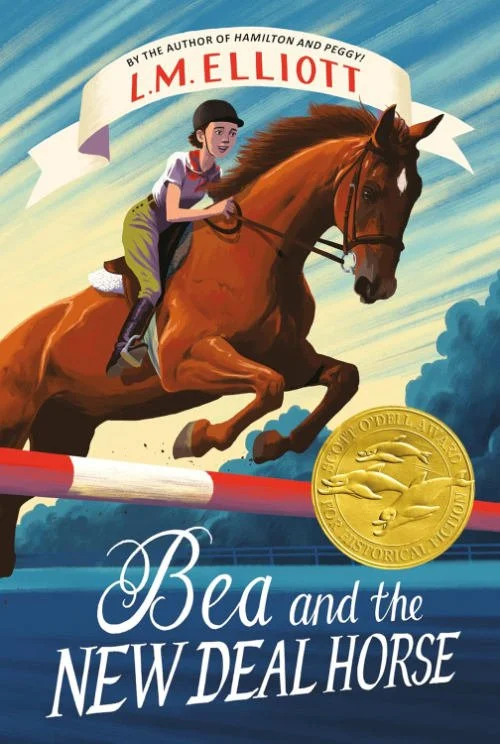
I recently came across this book by L.M. Elliott, published in 2024. Historical fiction and horses, two of my favorite topics!
The historical aspects of the book appear to be pretty accurate and were woven skillfully into the story, so it didn’t read like a textbook. I also appreciate Elliott’s use of a higher level vocabulary than you typically find in juvenile books. I think illustrations would have added a lot to the book; however, there are none.
The take on political persuasions is a bit left-leaning. The “New Deal” in the title refers to the hope that President Herbert Hoover will be replaced by FDR in the upcoming election. It’s believed his New Deal will end the horrible economic problems in the US. On the other hand, I have read many sources that claim FDR’s policies didn’t cure but actually prolonged the depression. Sometimes, I don’t know what to believe about our history. Elliott uses “Great Depression” in the text. From what I can gather, it was not widely called The Great Depression until years later. She touches on other topics of the day, such as farm foreclosures, penny auctions, racism, and classism.
But, if you’re reading this review, you’re probably more interested in the horse aspects of Bea and the New Deal Horse. Major spoiler alert for the content that follows.
Bea (Beatrice), the thirteen-year-old main character, finds herself in charge of her eight-year-old sister, Vivian. Their mother had recently died, and their alcoholic banker father abandoned them at Mrs. Scott’s horse farm. Bea’s rough language and demeanor strike me as rather odd for the daughter of a banker who had likely lived a pretty easy life prior to her father’s loss of a job when his bank closed. Mrs. Scott is facing financial difficulties of her own and the possibility of losing her farm with the area (Virginia) enduring drought conditions.
A vicious chestnut horse, Vulcan, colics one night. Bea enters the stall of the horse who is violently thrashing around. He tries to bite her when she enters. Then, she does something so stupid, it’s hard to believe the author included it!
“I leaned over to blow, gently, into his huge nostril. If he bit at me again, he could take a hunk of my face. … It was the only thing I could think of to get him to trust me - fast.” ch. 6
Of course, the horse doesn’t bite her, and Bea saves him by walking him all night.
Later, when Vivian is cornered by the chestnut, a stable hand, Ralph, enters the stall to rescue the girl. He is attacked by Vulcan and suffers a concussion, gashed forehead, broken arm, and broken ribs.
Mrs. Scott’s first thought was to sell the horse to the glue factory. But, soon after that, Bea starts riding Vulcan, whom they rename Sunup, the New Deal Horse. There is a hunter show a month away which Bea plans to show him in. They will also show two other horses. The hope is that if the horses do well enough they can sell them at the show, making enough money to save the farm. Later that month, Sunup is frightened by nearby explosions caused by a charlatan rainmaker. He throws Bea, whose foot is caught in the stirrup, and drags her for several strides. Amazingly, she is not seriously harmed and recovers in time to participate in the show and win her class on Sunup. It turns out Mrs. Scott made enough money on the sale of the other two horses, so she didn’t have to sell Sunup.
It’s a common theme in children’s horse books - a young girl rapidly tames a vicious/wild horse, is unharmed in the process, and all miraculously turns out well in the end. In this case, it is a horse that tried to attack her younger sister and nearly killed a man. It’s just over-the-top unbelievable.
Additionally, there is a fair amount of using “God” disrespectfully. I read this as an ebook on the Libby app, so I don’t have page numbers, but I’ll list a sampling of examples with the chapter numbers.
“Oh my G**, what about Vivian?” ch. 2
“For G**’s sake, young lady, find those stirrups.” ch. 7
“G**, almighty, how old was this man?” ch. 13
(many more, you get the idea)
For some reason, the author included Vivian’s fascination with a Ouija board. Of all the things for an eight-year-old to bring along when their family has lost everything, that would not have topped my list.
“At night, Vivian insisted on pulling her Ouija board out from her little suitcase and asking it when Daddy would find a job.” ch. 6 (Bea hadn’t told her their father had abandoned them.)
I really wanted to like this book. The premise is good, but the improper use of God’s name, the Ouija board, both parents absent, and the dangerous interactions with a “vicious” horse make it something I can’t recommend.
I liked this quote from chapter 26. Bea believed Sunup would be sold, and she decided to make the best of it.
“If I had learned one thing, it was to try to savor every fleeting moment of happiness for all it was worth, as spiritual vitamins against the soul-sickening hard times.”