Horse Academy SmartGames Review
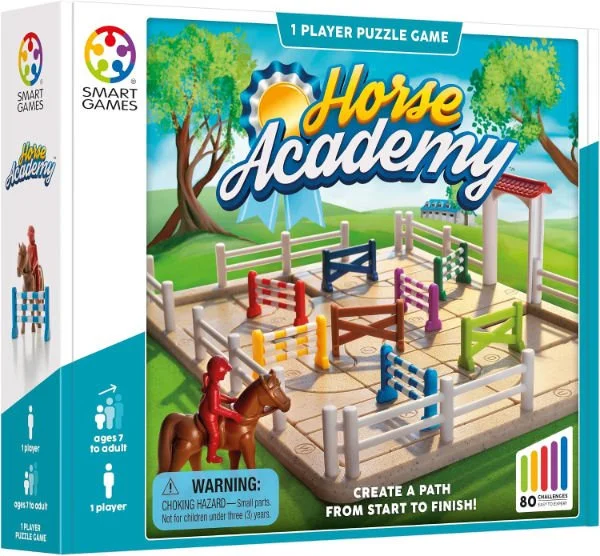
I have to confess, I’m obsessed with these SmartGames logic games/puzzles. When I saw they had a horse one, I had to try it.
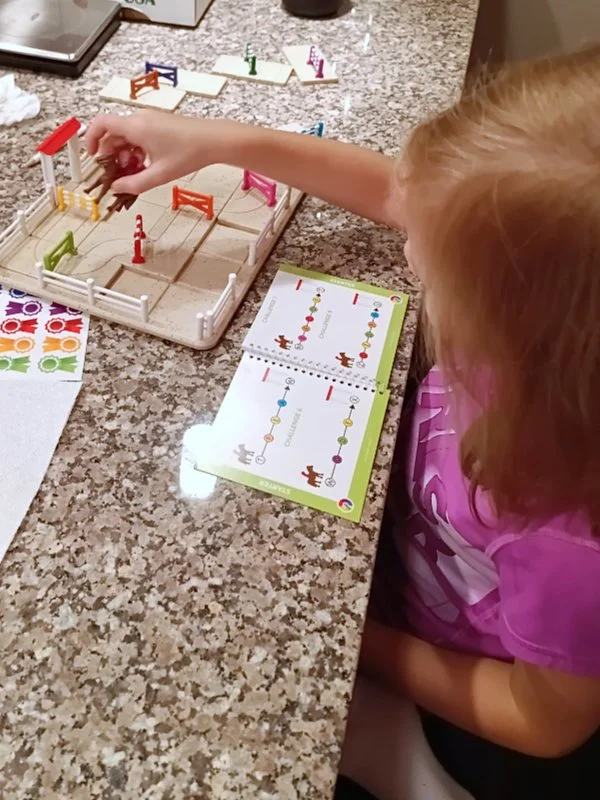
Horse Academy is the SmartGames version of an equestrian jumping course.
All the SmartGames contain quality, durable pieces. The Horse Academy pieces are plastic. The base has engraved squares which hold the jump tiles. The base has a fixed fence around it with gate openings labeled T, U, W, X, Y, Z. As far as I can tell, those letters don’t correspond to any events in the real horse world.
There are ten jump tiles lettered A to J. The tile letters are a bit hard to read. It’s easier to identify the jumps by color.
Six of the jump tiles contain a single path, meaning the horse cannot change direction on it. Four tiles provide a fork or optional direction. The fork tiles are needed when you have to make a loop in the jump path.
Place the horse and rider, all one piece, at the start of the course. An arched gateway goes at the end of the course. In all reality, the horse and gateway aren’t absolutely necessary, but younger players will probably enjoy using them.
The game booklet contains eighty puzzle challenges, ranked from starter to wizard. The puzzles progress in difficulty, and solutions are given in the back.
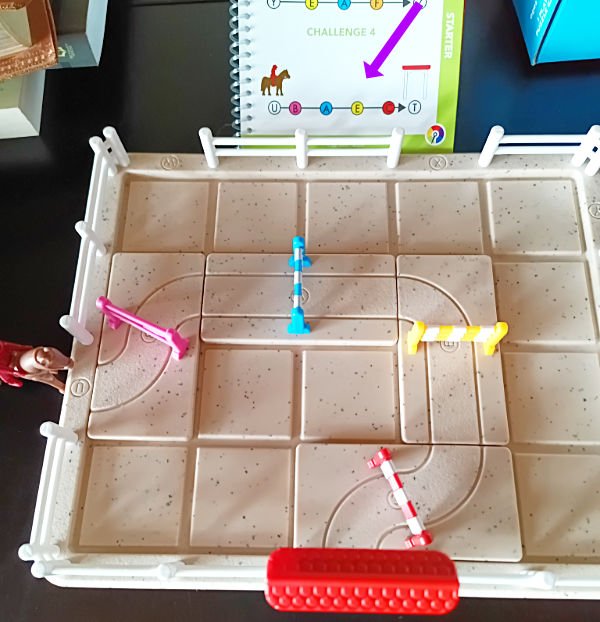
Take a look at Starter Challenge 4.
The first white circle shows where your horse and rider will start. In this case, we’d place the horse outside Gate U. The final white circle shows the end of the course, T. The gate will slide over the fence posts at that location. This gives you a good visual of the course your horse should run.
The color codes in the booklet show the order your horse will take the jumps. In the simpler puzzles, the jump order matches the order you place the tiles.
First, place the Pink/B jump so that the path allows the horse to enter at gate U and jump the pink jump. Some tiles may be placed in several directions, so you need to sort out which way the tile should be placed.
Next, comes the Blue/A tile. It has a straight path and can only be placed one way to connect with the previous tile. Your horse must exit at T, so you need to curve around to reach that gate. The remaining two jumps are placed to reach that gate. Easy enough, right?
Some of the challenges have you enter and exit through the same gate. The only way you can do that is to create a loop in the path, so the horse circles around and possibly jumps one or more jumps multiple times (from opposite directions). In order to create those types of paths, you need the jumps that have a fork option.
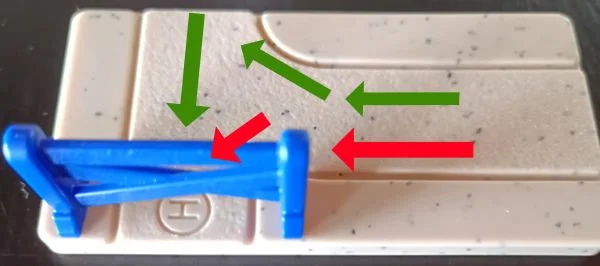
Here is one example, the Dark Blue/H jump. My green arrows show that this tile can be navigated two ways. The horse could follow the straight section of the tile and take the blue jump. If it comes in from the right, it can follow the curved green path and go out the top, without taking the jump at all. The red arrows show the direction the horse cannot take. It cannot make that sharp turn and take the jump!
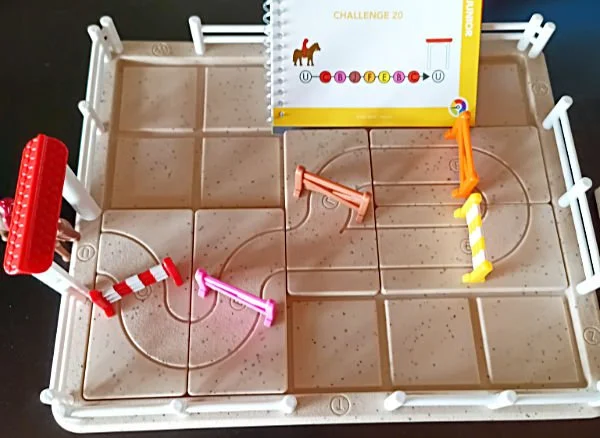
Challenge 20 requires that we create a loop. The course begins and ends at Gate U. This one is pretty straightforward. Red, Pink, then Brown is the forked tile. After jumping Pink, the horse takes the left fork and jumps Brown, then Orange and Yellow. The straight path of the Brown tile provides the way back to jump Pink and Red each a second time and finish out the U gate. A little more challenging but still not too bad.
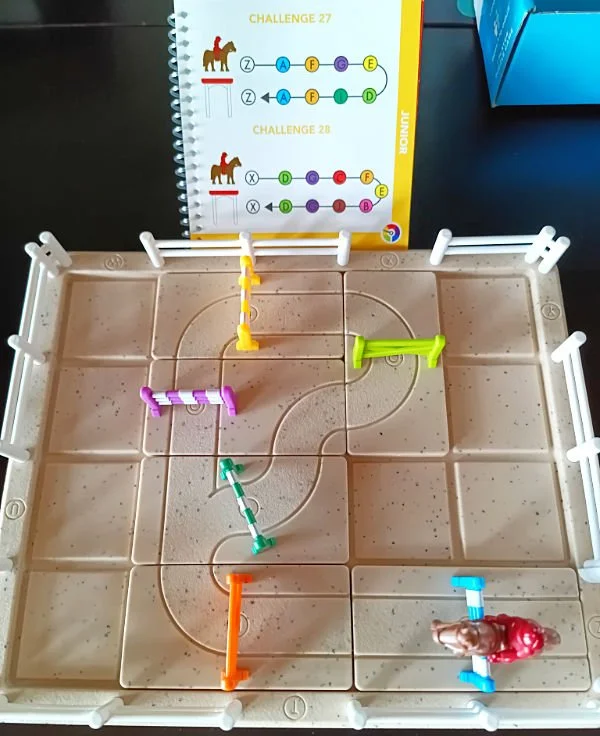
Let’s look at Challenge 27. I was stumped when I first got to this level. This is another looped path, starting and ending at Z Gate. You’re going to jump two gates, A and F, at the beginning and end of the course. The challenge shows A, F, G, as the first three jumps. The part that tripped me up was that I tried to place tile G right after F. It will not work that way.
The secret is that after Orange/F, you have to place the Dark Green/I tile even though that is the sixth jump in the course. The horse takes the straight path on I, thereby avoiding that jump until later, but that tile is used to get you to Purple/G, the next jump in the pattern. This is the kind of pattern that gets really tricky!
Why do I love SmartGames?
I was a computer programmer for years. I love logic. But you don’t have to be a programmer to enjoy and benefit from these games/puzzles. They help develop problem solving and critical thinking skills which carry over to other areas of life, skills that are sorely needed in our world today.
They are for a variety of ages. Most of the games have an indicated beginning age, but adults will enjoy them, too. Horse Academy lists age 7 as the younger end. My granddaughter is currently seven. She’s done a lot of the SmartGames and gets pretty far in many of them, but Horse Academy will be challenging for most seven-year-olds. In a way, that is good. It will engage her for many years. I am only at the Junior level myself, so far! Although they are “single-player,” it’s fun to work on the games with someone else. My granddaughter and I often work together to solve them.
If you make it to the end of the challenge book, put the game aside for a few weeks or months. Then, you can come back to it and enjoy the challenge again when you start all over.
I really appreciate having a physical product for kids to manipulate versus an electronic device.
Should I start with Horse Academy or another SmartGame?
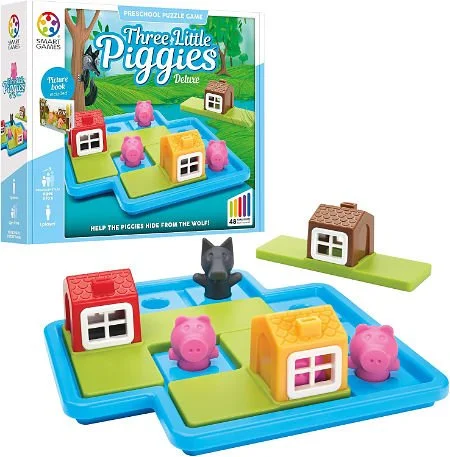
I first learned about SmartGames years ago when I had a foster daughter. She was a bright kid, but her education was behind schedule. I searched for things to help develop her thinking skills and ability to focus. We started with the magnetic Noah’s Ark SmartGame. That was one of their very early games. I still have it, and it’s still as fun as when I first got it. We moved on from there to the Three Little Pigs.
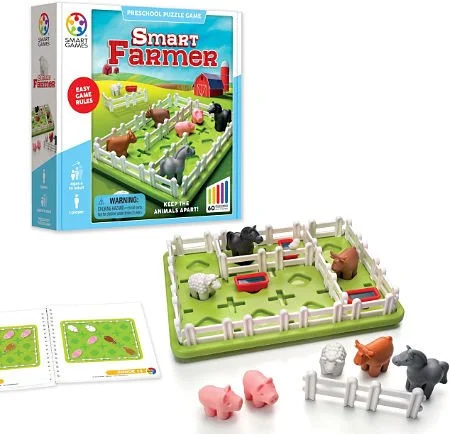
One of the first SmartGames my granddaughter enjoyed was SmartFarmer. I got that one when she was four. At first, all she did was play with the animals. But by five, she could go through the entire challenge book.